



This is the final piece of a five-part series drawing on Juicebox Founder Joel Pember's time at SXSW London 2026.
On earned conviction, the efficiency trap, and what actually becomes more valuable as everything else gets cheaper.
I want to close this series with the idea that stayed with me longest from SXSW London. Not a framework or a case study. A question.
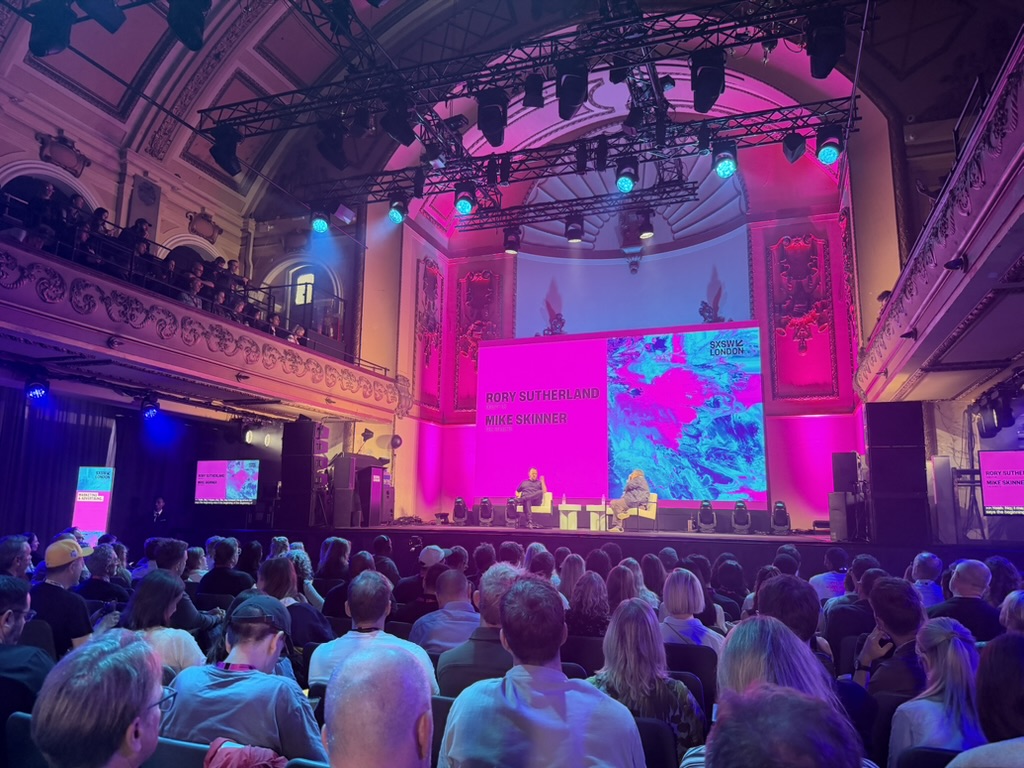
It came from Mike Skinner, of The Streets, during an open conversation with Rory Sutherland, who offered the clearest version of something I'd been trying to articulate all week.
If you own a small business with ten people, do you fire nine of them so that the one who's left can 10x their output at lower cost? Or do you give all ten people the ability to chase a 10×10 gain if the market opportunity is there?
The efficiency instinct, especially in times of uncertainty, is to do the first. The growth instinct is to do the second. And the honest observation from most of the sessions at SXSW is that businesses are defaulting to the first while telling themselves they're doing the second.
Sir Martin Sorrell from S4 Capital and Monks was direct about where this lands. He sees the market resolving into two tiers: fewer but better-paid strategic and creative people at the top, with implementation heavily automated below. He rejected the "95% of jobs disappear" line; he thinks AI redistributes work rather than simply destroying it. But he does expect headcounts to sharpen, and he expects the sharpening to be uneven.
Azeem Azhar's quieter concern landed harder. His real worry is for the 20-to-26-year-olds losing the entry rung at exactly this moment. The junior roles that were never glamorous but were where you learned to think, to manage, to absorb the ten thousand hours that eventually earned the right to an opinion. That pipeline matters, and it's under real pressure.
Which brings us to the idea that connects everything in this series.
The efficiency race, pursued for its own sake and aimed primarily at the bottom line, leads to the average. And the average is precisely what's becoming free.
If AI hands everyone a serviceable competence at almost everything, being a broad generalist stops being a safe position. It's exactly the ground being flooded by slop. What AI cannot hand anyone is the accumulated experience: the failures absorbed, the challenges navigated, the wins built over years and the relationships that came with them. The earned conviction that lets you hold an opinion, be an authority, steer something toward an outcome you can already see because you've seen enough to know what it looks like.
That earned conviction is the one thing that can't be shortcut. And it's fast becoming the most valuable thing a person or an organisation can own.
Hugh Bonneville said it first, in the opening session, talking about his own likeness. Know exactly which traits are distinctively yours. Refuse to let them be reproduced on demand. It was the right frame at the start of the week, and it's the right frame to end it.
The intelligence age doesn't erode the value of what you've accumulated. It clarifies it.
So what do you actually do?
Drawn together across all five pieces in this series, the practical agenda is consistent. These are the questions worth sitting with, and the actions worth taking.
Aim to grow the top line, not just reduce the bottom. Durable value comes from being chosen by more people. Ask of every AI initiative: is this making us cheaper, or is it making us more distinct?
Redesign the entire loop, don't bolt on the tool. Find an end-to-end process you can rebuild around AI and instrument it so you can see what's working. Making one role faster while jamming the next is not transformation. It's the relocation of the problem.
Build your enterprise brain. Your accumulated knowledge, context, and proprietary data are the moat that can't be copied. Your unique organisational intelligence is neither. Start building the structured, queryable layer that makes both your people and your agents sharper.
Codify your distinctiveness before the generative output begins. Write your brand and point of view as operational logic a machine can act on. A brand that only exists as guidelines written for humans has no brief for the AI systems interpreting it on your behalf.
Build a voice, not just a brand. A coherent identity only compounds if people hear it. Treat owned content and trusted in-house voices as core infrastructure. In a world of infinite generated content, a credible human voice that carries a point of view is genuinely scarce.
Draw the sovereign line. Decide what you must own versus what you can rent. The non-negotiable core is wherever being copied or owned would compromise the story you tell. Own that deliberately. Integrate freely everywhere else.
Move before the threat is undeniable. The comfort of doing fine is the most dangerous position. Assume someone will cannibalise your model. Make sure it's you doing the eating.
Become more specialised, not less. Depth over breadth is the only ground that isn't being flooded. Invest in genuine expertise, in craft, in category, in client relationships. Build AI around that expertise rather than instead of it.
If any of this resonates and you're wondering what it means for your own business, that's exactly the conversation we have at Juicebox.
Whether it's defining what's distinctively yours, building and orchestrating the systems that protect and broadcast it, or finding the end-to-end process worth redesigning, we'd be glad to think it through with you.
About SXSW London
SXSW London is the leading European platform for convergence and cross-industry collaboration, celebrating the intersection of business, technology, creativity, and culture. The 2026 edition ran from 1 to 6 June across dozens of venues, galleries, clubs, and independent spaces in Shoreditch, east London. Welcoming over 20,500 delegates from 77 countries in its inaugural year, it builds on the SXSW brand's decades of success in Austin and Sydney and its established reputation as a global platform for discovery.
About the author, Joel Pember
Joel Pember is the founder of Juicebox, a Perth-based design intelligence studio operating across Australia and Southeast Asia. Currently on sabbatical in Europe, Joel is spending time immersed in the ideas, conversations, and events shaping the next chapter of the industry. This series draws on his time at SXSW London 2026.