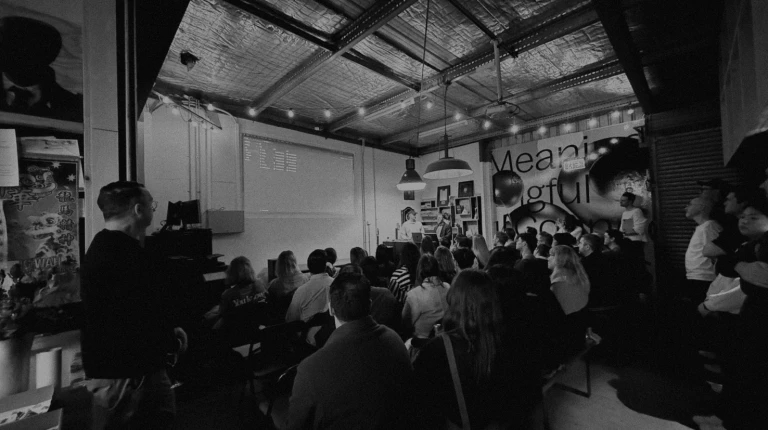

Yesterday's livestream pulled together voices from Figma, Atlassian, and customer experience futurist Katja Forbes to work through something most product teams are wrestling with quietly: how AI is reshaping roles, rituals, and the texture of product design itself.
The focus throughout was digital and product design specifically; the people shaping software experiences, design systems, and the interfaces where customers meet a business. The conversation was less about tools and more about temperament; how teams stay grounded when the ground keeps moving.
Five ideas from the conversation stayed with us.
1. Survival via disruption
The meta theme landed early. "Disrupt yourself before someone else does." Or, put differently: to survive disruption, you have to become the disruption.
What kept this from sliding into bravado was the honest acknowledgement that the human brain isn't quite built for the pace of what's arriving. One panellist described it as having "too many tabs open"; a recognition that the cost of adapting fast is usually paid in attention and care. Look after yourselves, was the subtext.
The invitation wasn't to panic. It was to participate. You can opt out and lean in hard to a design niche; that's a legitimate choice. Just know that product design will keep moving without you. Figma's own State of the Designer 2026 data lines up here: product designers who are increasing their AI use report more satisfaction and a more positive outlook than those whose usage has stagnated. Momentum, it seems, is protective.
2. Show up with something
One of the sharpest shifts is in how product design meetings begin. The new expectation: don't arrive empty-handed. "What have you already explored or prototyped?" is becoming the default opening question.
That reframes the cost of exploration. When a rough prototype takes hours rather than weeks, turning up with a point of view becomes table stakes. It also changes who brings that point of view. PMs, engineers, and founders are walking into design reviews with vibe-coded prototypes of their own.
The panel's response to that dynamic was deft. Acknowledge the idea, then pivot: "I love the idea, AND let's refine it." The conjunction matters. "But" closes a door; "and" keeps the craft conversation alive.
The underlying workflow shift is simple. Use AI to design quickly, get it in front of customers to test, and let the evidence do the arguing. Hypothesis, experiment, progress.
3. Where designers reinvest the time
If AI collapses the cost of producing an artefact, where does the human work go in a product design process? Two answers surfaced repeatedly.
The first is problem shaping. When you can generate infinite iterations of a feature or flow, the discipline of choosing the right thing to build matters more, not less. The second is augmentation. Product designers are being asked to identify the handful of activities where AI genuinely 10x's their output, and to be honest about the areas where AI can lift a weaker skill up to par.
Figma's 2026 report echoes this. An Italian product designer quoted in the study puts it cleanly: the craft has matured, and the value now sits in systems thinking and translating complexity into clarity.
4. The triad, and the humans inside it
Team shape came up too. Atlassian and Katja Forbes both pointed to the triad model; product, design, and engineering working as equal partners. It's the Silicon Valley shape, and it's well suited to a moment where each function is absorbing new capability at once.
Alongside the structural point was a human one. People need reassurance right now. Leaders who can articulate how AI creates value for their team, who get hands-on rather than hand down directives, and who signal that it's genuinely going to be okay, are building teams that can move through this period without losing each other along the way.
That aligns with something Figma's report makes plain: designers are 60% happier when leadership visibly cares about craft.
5. Start with exploration, not strategy
The closing counsel was grounded. Start with exploration; understand the raw materials first, then figure out what actually fits your company. Don't take any of it as gospel, including this. Question it, use it to form a hypothesis, ship something small, and learn.
What we're taking from it
We're in, as the panel put it, "the beginning of the start." That phrase is doing a lot of work. It acknowledges the disorientation without collapsing into it. It insists on curiosity over certainty.
For teams building digital products right now, the brief is fairly simple, even if the execution isn't. Get hands-on. Bring something to the table. Protect the time for problem shaping. Work in triads. Be generous with reassurance. And keep craft as the thing that makes the product unmistakably yours.
If you’d like a copy of the 2026 Figma design report get in touch.